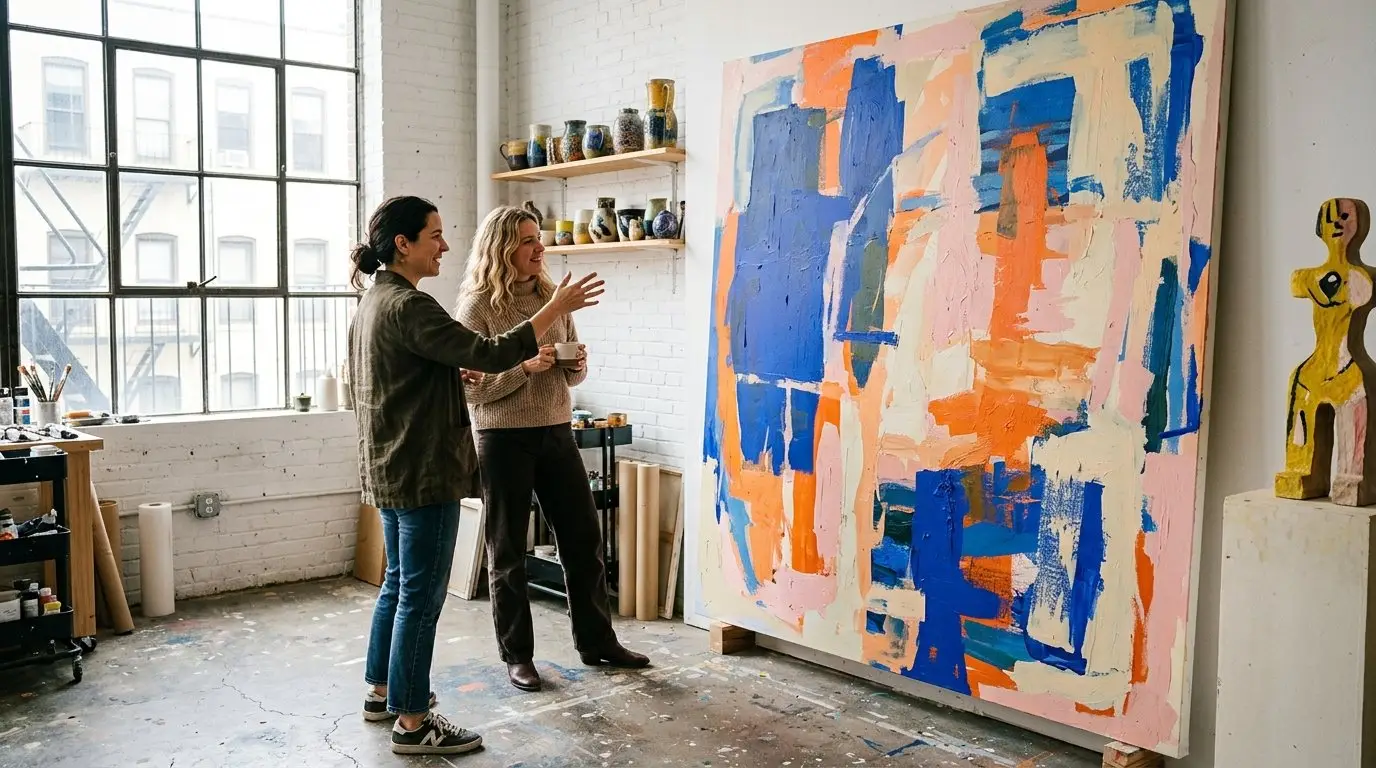
Someone has climbed your stairs and is standing in your studio. Most artists find this harder than any other part of selling, because there is no script. You are the host, the guide and the maker at the same time, and nobody told you when to talk and when to be quiet.
Here is the good news. Visitors come expecting a conversation, not a sales pitch, and they are usually as unsure as you are. If you give the visit a simple shape, both of you relax. This chapter gives you that shape: how to open, what to tell them, when to stop talking, and how to end it without pressure.
1. The first two minutes
Get up, go to the door, and say hello. Then do three things:
- Say your name and theirs. “Hi, I’m Sam. You must be Ana?” If they did not write first, just ask.
- Take their coat or show them where to put it. Holding a bag makes people feel like they are about to leave.
- Tell them how it works. “Have a look around, everything on the main wall is finished work. Ask me anything, and take your time.” This one sentence removes most of the awkwardness, because now they know the rules.
Then use the three sentences you prepared in Getting your studio ready for a visit: what you are working on now, what the work on the wall has in common, and a question back to them.
2. Let them look before you explain
People look at art for less time than you think. In a study at the Art Institute of Chicago, visitors spent a median of 21 seconds with a work of art (Smith, Smith and Tinio, 2017). In your studio people will look longer than that, but only if you let them.
- Give them a minute or two of quiet at the start. Do something small and nearby, like tidying a table or making coffee.
- Watch where they stop. The work someone keeps coming back to tells you more than anything they say.
- Go over when they stop in front of something, not before.
3. What to tell them
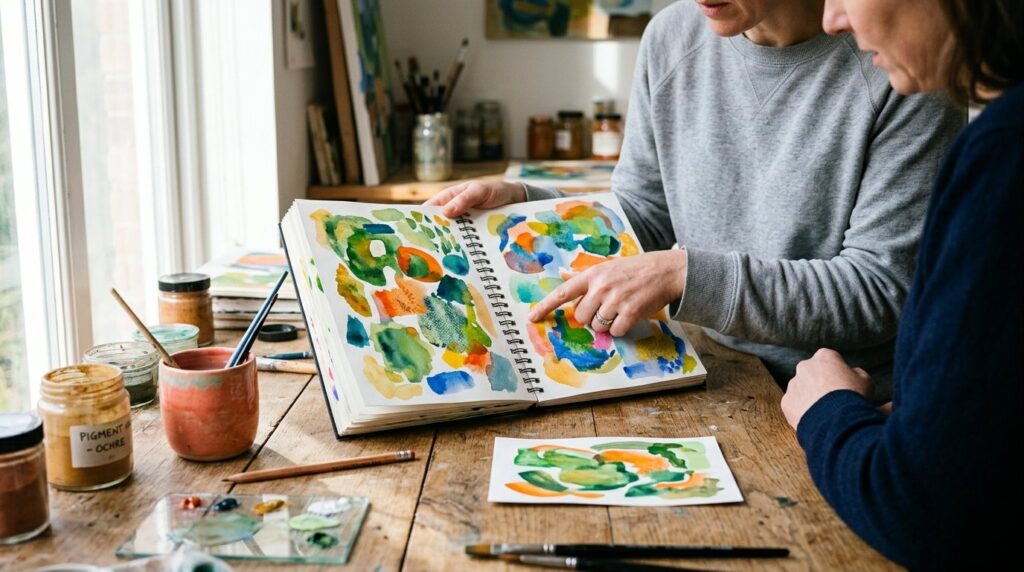
The thing a studio visit offers that a website cannot is the process. People value original work partly because it came from the artist’s own hand (Newman and Bloom, 2012). Your studio is the only place they can see that hand at work.
So talk about how, not about what it means:
- How a piece started, and what changed along the way
- The material: where it comes from, what it does, what goes wrong with it
- The study or the failed version that led to the finished one
- What you are trying next
Point at things. Hand them a sketchbook if you are happy to. Let them touch a sample of the material if it is safe to touch. A detail they discovered themselves stays with them longer than one you explained.
4. When to stop talking
This is the one most artists get wrong, out of nerves rather than ego. Some signals that it is time to go quiet:
- They step back from the work, or move to the next piece
- Their answers get shorter
- They start looking at a work while you are still talking about another one
A good rule: after answering a question, stop. Do not add a second story. If they want more, they will ask. Silence in a studio is not awkward, it is looking.
5. When they ask about price or buying
Have your price list on you, as covered in the preparation chapter. When someone asks:
- Say the price plainly. “That one is 1,200 dollars.” No explanation of hours, no apology.
- Then stop talking. Let them think. Filling the silence with a discount is how artists undersell themselves.
- If they want it, agree the next step right there. A deposit to reserve it, or full payment, and how it gets to them. Selling a work: payment, packing and delivery covers all of it.
- If they are not sure, offer to hold it briefly. “I can hold it until Friday if you want to think about it.” A short, clear deadline is kinder than an open one.
Most visits will not end in a sale, and that is normal. Many sales happen later, after someone has seen the work in person and thought about it. The visit is what makes that later sale possible.
6. How to end it without pressure
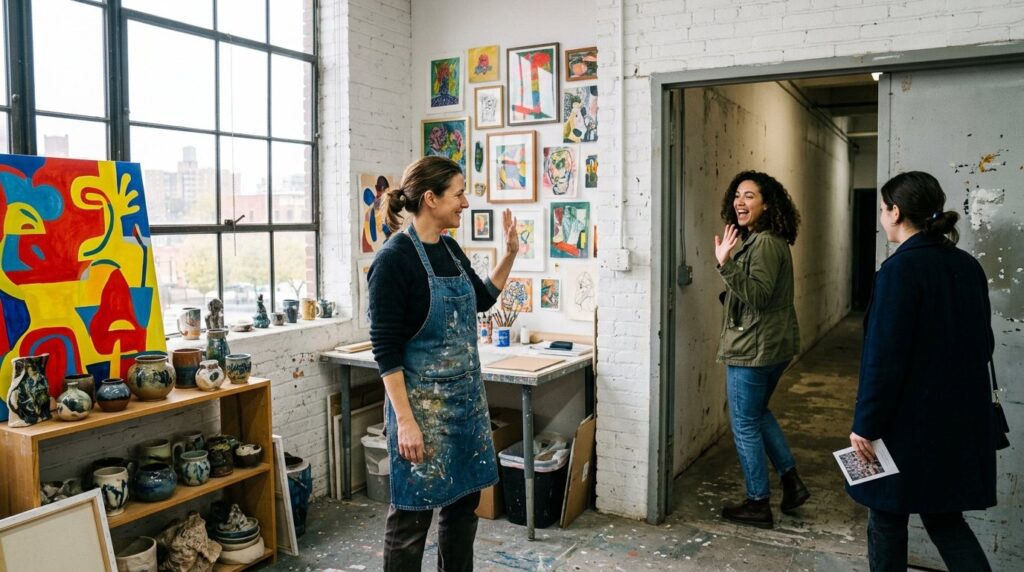
Visits usually end on their own, after twenty minutes to an hour. When you feel it winding down, make leaving easy:
- “Thank you for coming, it is good to show the work to someone in person.”
- Offer something to take away: a card with your name and your page, or a small printed list of works with prices.
- Ask if they would like to hear about your next open day. If they say yes, take an email address, write it down, and ask if it is fine to write to them. Do not collect addresses from people who did not offer them.
What you never do is ask “So, are you interested in anything?” at the door. If they were, they would have asked. That question turns a good visit into an awkward goodbye.
7. Right after they leave
Take two minutes and write down:
- Their name and how they found you
- Which works they stopped at
- Anything they said that you want to remember
- Whether they asked about a price or wanted to be kept posted
You will not remember it next week, and you will need it for the follow up. After the visit: the follow-up explains what to do with it.
The short version
- Greet them at the door, take their coat, tell them how it works
- Let them look in quiet first, then go over when they stop at something
- Talk about process and material, not about meaning
- Answer the question, then stop
- Say the price plainly and let the silence be
- End with thanks and something to take away, never with a sales question
- Write down what you noticed as soon as they leave
Sources
- Smith, L. F., Smith, J. K., and Tinio, P. P. L. (2017). Time spent viewing art and reading labels. Psychology of Aesthetics, Creativity, and the Arts, 11(1), 77 to 85.
- Newman, G. E., and Bloom, P. (2012). Art and authenticity: The importance of originals in judgments of value. Journal of Experimental Psychology: General, 141(3), 558 to 569.