
Someone has said yes. This is the moment many artists are least prepared for, because a gallery or a platform usually handles it. On HEYATELIER you do, since the sale is between you and the buyer and we never touch the money. That means you keep the full price. It also means you need a simple, calm routine for everything that comes after “I’ll take it”.
This chapter covers the invoice, payment, packing, pickup or shipping, and what to keep for your own records. It is practical guidance, not legal or tax advice. For your own situation, check with an accountant.
1. Agree the details in writing
Even with the nicest buyer, confirm the sale in a short message or email before anything else. It avoids almost every later misunderstanding.
- The work: title, year, medium, size
- The price, and whether it includes the frame
- Sales tax, if you charge it (see section 6)
- Delivery: pickup, delivery by you, or shipping, and who pays for it
- When the work leaves the studio
2. The invoice
A simple invoice works as your receipt and as the buyer’s proof of purchase. It does not need special software. Include:
- Your name, address and contact details
- The buyer’s name and contact details
- Date and an invoice number (keep your own numbering, 001, 002 and so on)
- Title, year, medium and dimensions of the work
- Price, any sales tax, any shipping cost, and the total
- How to pay and by when
- A line on copyright (see below)
About copyright. Under US law, selling the physical work does not transfer the copyright. The buyer owns the object, you keep the right to reproduce the image, unless you agree otherwise in writing (17 U.S.C. section 202). A line like “Copyright in the work remains with the artist” on your invoice makes that clear to everyone.
3. Payment
Keep it simple and get paid before the work leaves.
- Bank transfer is the cleanest for larger amounts. No fees in most cases, and a clear record.
- Payment apps and card readers are convenient for smaller works and for sales on the spot during an open day. Check the fees and the rules of the service you use, especially for business payments, before your first sale.
- Cash is fine for small works. Give a receipt anyway.
- Deposits. If someone wants to reserve a work, a deposit is normal. Agree in writing what happens to the deposit if they do not complete the purchase.
The one firm rule: the work stays with you until the payment has actually arrived in your account. Not “sent”, arrived. That protects you from almost every kind of scam.
4. Pickup and local delivery

For buyers in your city, pickup is often the nicest option. They come back to the studio, you hand the work over, and the relationship gets one more good moment.
- Agree a time, and have the work wrapped and ready when they arrive.
- Ask how they are transporting it. A large canvas does not fit in every car.
- If you deliver yourself, agree the cost up front, and help hang it only if you want to.
5. Packing
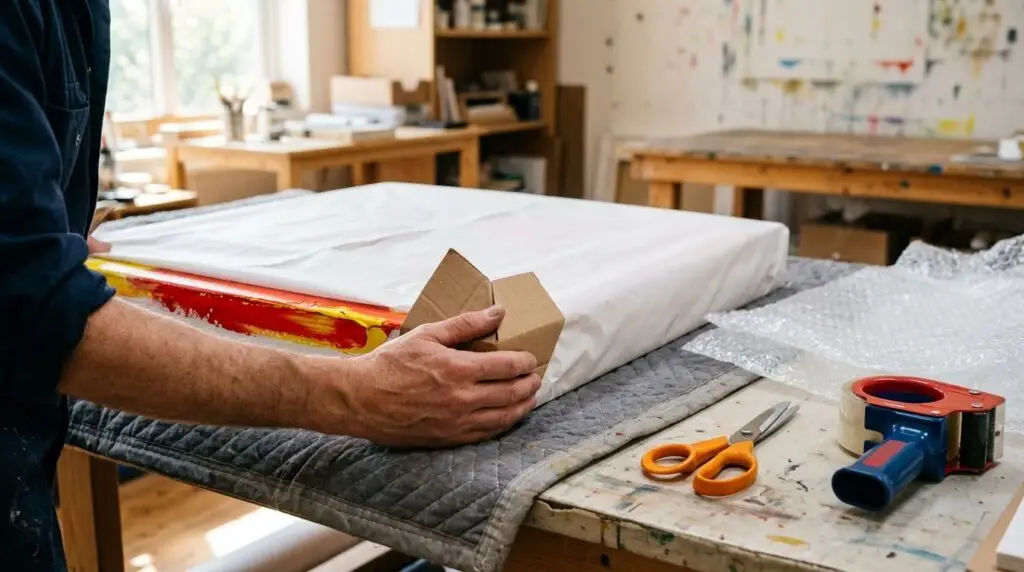
Whether the buyer carries it home or it goes by courier, pack it properly. Conservation guidance comes down to three layers: something soft and clean against the work, cushioning around it, and a rigid outer box so nothing can move (Canadian Conservation Institute).
- Handle with clean, dry hands. Hold paintings by the edges or the frame, never by the stretcher bars pressing into the canvas, and never by the hanging wire.
- A clean layer against the surface. Acid-free tissue or glassine against the front, never bubble wrap directly on paint or glazed surfaces, which can leave marks.
- Protect the corners. Cardboard corner protectors on paintings and framed work. Corners are where most damage happens.
- Cushioning. Bubble wrap or foam around the wrapped work, so it cannot touch the sides of the box.
- A rigid outer box. For shipping, a double box: the wrapped work in one box, cushioned inside a second, larger one. The work must not shift when you shake the box.
- Label it. “Fragile”, which side is up, and your contact details inside as well as outside.
For ceramics and sculpture, wrap every protruding part separately and fill all empty space, so nothing inside the box can move.
6. Sales tax
Sales tax rules differ per state, so check the rules where you sell. In New York State, a business that sells tangible goods, and art counts, needs a sales tax Certificate of Authority to make taxable sales, and you have to apply at least 20 days before you start (New York State Department of Taxation and Finance). Registration is done online.
If you are not sure whether this applies to you, ask an accountant before your first sale rather than after. It is a short conversation and it saves you trouble later.
7. Shipping
- Get a quote before you give a total price. Shipping a large framed painting can cost far more than you expect.
- Check the carrier’s rules on artwork. Carriers often set maximum declared values for items such as artwork. FedEx, for example, says so on its declared value page and refers to its service guide. For valuable work, look at a specialist fine art shipper or separate insurance.
- Use tracking, and send the buyer the tracking number the day it goes out.
- Take photos of the work before packing and of the closed box. If something goes wrong, you will need them.
8. What to keep for your own records
Set up one folder, paper or digital, and put every sale in it:
- A copy of the invoice
- Proof of payment
- The buyer’s name and contact details, if they agreed you could keep them
- A good photo of the work, with title, size and date sold
- Shipping receipts and tracking numbers
At tax time you will need it. And in ten years, when someone asks for a retrospective list of where your work went, you will be glad you have it.
The short version
- Confirm the sale in writing: work, price, frame, tax, delivery
- Send a simple numbered invoice with a copyright line
- The work leaves only after the money has arrived
- Pack in three layers: clean wrap on the surface, cushioning, rigid box
- Check your state’s sales tax rules before your first sale
- Get a shipping quote first and check the carrier’s rules on artwork
- Keep one folder with every invoice, payment and photo
Sources
- 17 U.S. Code section 202: Ownership of copyright as distinct from ownership of material object.
- Canadian Conservation Institute. Basic Handling of Paintings, CCI Notes 10/13 and Features of Effective Packaging and Transport for Artwork, Technical Bulletin 34.
- New York State Department of Taxation and Finance. Selling products or services.
- FedEx. Declared value and limits of liability.