Understanding Art: A Beginner's Guide to Looking at Art
Most people walk past art faster than they read a menu. They glance, decide whether they like it, and move on, a little worried that there was something they were supposed to get. If that sounds familiar, you are in good company, and you are not missing a secret code. Understanding art is a skill, and like any skill it comes from a few simple habits repeated often.
This guide gives you those habits. It covers what actually happens when you look at a work, a step by step way to look at anything from a small drawing to a wall-sized painting, and how to keep learning without turning it into homework. If you are thinking about buying, our guide on how to start collecting art picks up where this one ends.
Why art can feel hard to understand
Art rarely tells you what it wants. A novel has a plot, a film has a story, a song has lyrics. A painting just sits there. It does not explain itself, and the label next to it is often written for people who already know the vocabulary.
That silence is the point, but it is also why so many people feel shut out. The good news is that the feeling of “I don’t get it” is usually a sign that you are looking for an answer, when what the work offers is an experience. Once you stop hunting for the single correct meaning, most of the difficulty goes away.
What happens in your head when you look at art
Psychologists have spent decades studying how people respond to art, and one of the most cited models comes from Helmut Leder and colleagues. They describe looking at art as a sequence. First you take in the basics: color, contrast, shapes, how complex the surface is. Then you compare what you see with what you already know. Then you try to classify it, by style or subject or artist. Finally you try to make sense of it, and that effort to master the work is what produces both a judgment (“I like this”) and an emotion (“this moves me”).
Two things follow from that model, and both are encouraging.
- **Liking a work is not the same as understanding it.** You can respond strongly to a painting long before you can say why. That first response is valid information, not a beginner’s mistake.
- **Knowledge changes the experience, but it adds to it rather than replacing it.** The more context you bring, the more there is to notice. You do not need all of it on day one.
The biggest mistake: not looking long enough
In a well-known study at the Metropolitan Museum of Art, Jeffrey and Lisa Smith watched visitors in front of famous paintings. The typical visitor spent well under half a minute with each work. When the study was repeated years later, the numbers barely moved, even though the second study counted time spent reading the label.
Half a minute is enough to recognize what a painting shows. It is not enough to see how it was made, what it does to your eye, or how it changes as you keep looking. The single most useful thing you can do to understand art better is also the simplest: stay longer. Pick one work and give it two or three full minutes before you read anything about it.
A simple method for looking at any artwork
You can use the following five steps in a museum, a gallery or an artist’s studio. They work for a landscape, a portrait or a canvas covered in a single color.
1. Notice your first reaction
Before anything else, check in with yourself. Do you like it, dislike it, feel nothing? Are you curious, irritated, calm? Write it down or say it to whoever you are with. You will come back to this at the end, and it is often interesting to see whether it changed.
2. Describe what is actually there
Now describe the work as if you were explaining it to someone on the phone. What is the subject, if there is one? What colors dominate? Is the surface smooth or rough, thin or built up? How big is it compared to you? Description sounds basic, but it slows you down and makes you notice details your first glance skipped.
3. Look at how it was made
Get closer, then step back. Up close you can see brush marks, pencil pressure, layers of glaze, places where the artist changed their mind. From a distance you see how the parts work together. Ask yourself what choices the artist made: where they put the most detail, where they left things loose, what they decided to leave out.
4. Ask what it might be about
Only now start interpreting. What feeling does the work give off? Does the title add anything? Does the way it is made connect to what it shows? A rushed, scratchy drawing of a calm scene creates tension. A carefully finished painting of something ordinary asks you to take that ordinary thing seriously. There is rarely one right answer, but some readings fit the evidence better than others, and the evidence is what you gathered in steps two and three.
5. Return to your first reaction
Finally, go back to what you felt at the start. Has it changed? Many people find that a work they dismissed becomes interesting once they have spent time with it, and a work they loved at first glance turns out to be thinner than it looked. Both outcomes are useful. They are how your eye gets sharper.
Context matters more than you think
Where you see a work changes how you see it. In one study, David Brieber, Marcos Nadal and Helmut Leder showed the same artworks to people either in a museum or as reproductions in a lab. In the museum, people liked the works more, found them more interesting and remembered them better.
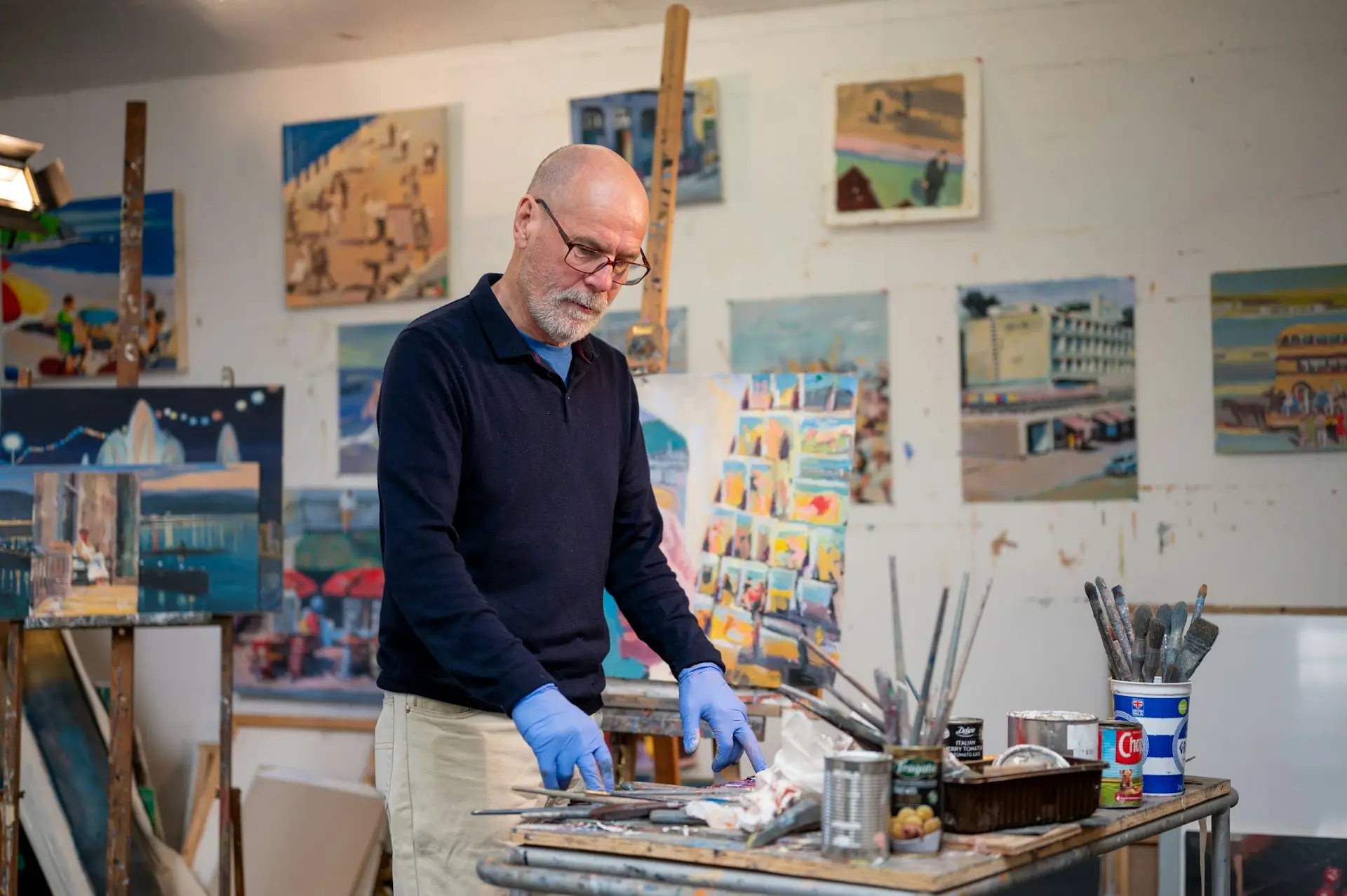
You can use this to your advantage. Seeing art in person, at its real size, with real light falling on a real surface, is a different experience from scrolling past a photo. It is also why a visit to an artist’s studio can be so powerful: you see the work where it was made, surrounded by the sketches, tools and half-finished pieces that explain how it came to be. Our piece on New York’s artist studios gives a sense of what that looks like.
You don’t need to be an expert, but expertise changes things
Research comparing art experts with people who have no training shows that the two groups often respond differently, particularly to abstract work. In a study by Pihko and colleagues, people without art training tended to prefer representational paintings, while experts responded more evenly across levels of abstraction.
That is not a reason to feel behind. It shows that taste is trainable. The more you look, the wider the range of work you can enjoy. Many people who start out only liking landscapes find, a year later, that they are drawn to work they would have walked straight past. That shift happens through exposure, not lectures.
How to read the label without letting it take over
Labels are useful, but they can short-circuit your own looking. A good habit is to look first and read second. Give the work your own two minutes, then read the label and see what it adds. Does it confirm what you noticed? Does it point to something you missed? Does it make a claim you disagree with? Treat the label as one voice in the conversation, not the final word.
The same goes for reviews, wall texts and audio guides. They are context. Your eyes are still the main instrument.
Questions that open up almost any artwork
When you get stuck, these questions help:
- What is the first thing my eye goes to, and where does it go next?
- What would change if this were twice as big, or half as big?
- What did the artist choose not to include?
- If this work had a sound, what would it be?
- Would I want to see this every day? Why or why not?
- What would I ask the artist if they were standing next to me?
That last question is worth taking literally. Most artists are happy to talk about their work, and a five minute conversation in a studio can teach you more than an afternoon of reading.
How to keep learning without making it homework
Understanding art grows the way a palate grows: through regular, low-pressure exposure. A few habits make a real difference.
- **Go often, stay short.** One focused hour in a museum or a few studio visits beats a marathon day where everything blurs.
- **Choose three works, not thirty.** Walk through a show quickly, then go back to the three that caught you and spend real time with them.
- **Keep a simple note.** A photo and two lines about why it stuck with you. Over time you will see patterns in what you respond to.
- **Talk about it.** Explaining a work to a friend forces you to put your impressions into words, which is when they become clear.
- **Meet the people who make it.** Artists can explain process in a way no label can. Visiting studios is one of the fastest ways to understand how and why art gets made.
Where to go next
This guide is the starting point for a series on understanding art. The next articles look at the difference between originals and prints, how to develop your eye, the major styles and movements, abstract art and contemporary art. Each one builds on the method above.
If you already know what you respond to and want to bring something home, read how to choose art you’ll love next.
Sources
- Leder, H., Belke, B., Oeberst, A., and Augustin, D. (2004). A model of aesthetic appreciation and aesthetic judgments. British Journal of Psychology, 95(4), 489 to 508. doi:10.1348/0007126042369811
- Smith, J. K., and Smith, L. F. (2001). Spending time on art. Empirical Studies of the Arts, 19(2), 229 to 236. doi:10.2190/5MQM-59JH-X21R-JN5J
- Smith, L. F., Smith, J. K., and Tinio, P. P. L. (2017). Time spent viewing art and reading labels. Psychology of Aesthetics, Creativity, and the Arts, 11(1), 77 to 85. doi:10.1037/aca0000049
- Brieber, D., Nadal, M., and Leder, H. (2015). In the white cube: museum context enhances the valuation and memory of art. Acta Psychologica, 154, 36 to 42. doi:10.1016/j.actpsy.2014.11.004
- Pihko, E., Virtanen, A., Saarinen, V.-M., Pannasch, S., Hirvenkari, L., Tossavainen, T., Haapala, A., and Hari, R. (2011). Experiencing art: the influence of expertise and painting abstraction level. Frontiers in Human Neuroscience, 5, 94. doi:10.3389/fnhum.2011.00094
See art where it is made
The best way to practice everything in this guide is in front of real work, with the artist nearby. Browse artist studios near you by neighborhood and medium, message any artist directly and ask to visit. Free to browse, free to message.
Header photo by Centre for Ageing Better
More from the blog
Original, original print, limited edition, giclée, poster. What each term actually means, how to tell them apart in pers...
Every sale through a middleman costs you a share. What galleries and marketplaces actually take, what selling commission...

A timeline: three weeks before, one week before, the day itself, and the day after.
One email a month. The new post, and nothing else.
New writing, open studio dates, and the date of the first HEYATELIER Weekend in New York. Unsubscribe in one click.
You confirm by email. We never share your address.