Original Art vs. Prints: What's the Difference?
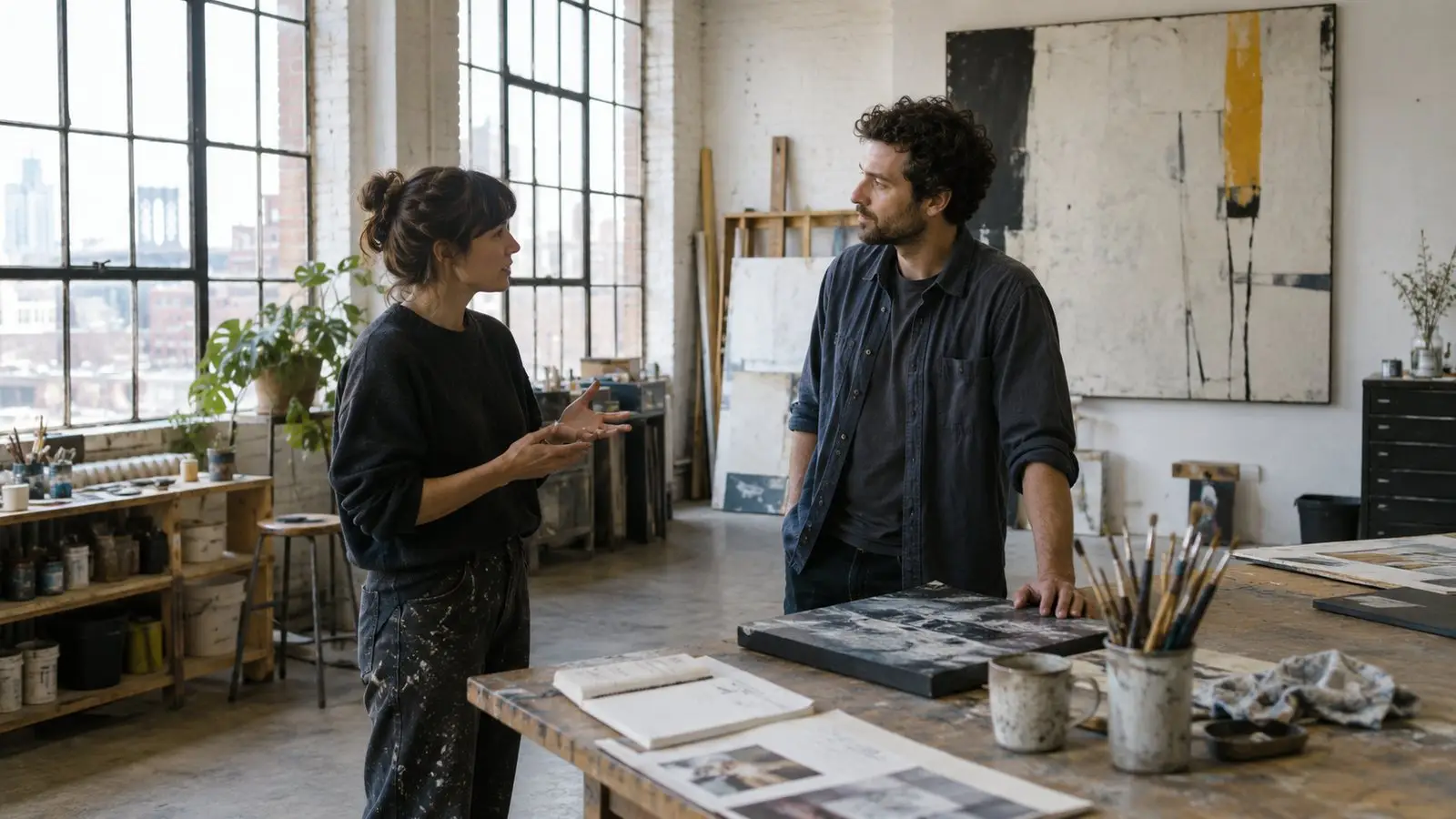
“Print” is one of the most confusing words in art. It can mean a hand-pulled etching the artist spent weeks on, a high quality inkjet copy of a painting, or a poster that costs less than the frame. All three can be sold as “art prints,” and the prices can differ by a factor of a hundred.
This guide sorts out the vocabulary, shows you how to tell the difference in person and helps you decide what is right for your wall and your budget. It builds on our beginner’s guide to understanding art.
What counts as an original
An original is a unique work made directly by the artist: a painting, a drawing, a collage, a sculpture, a photograph printed as a one-off. There is exactly one. If it is sold, nobody else can own it.
Originals carry the most direct trace of the artist’s hand. You can see where the brush slowed down, where the pencil pressed harder, where something was scraped back and redone. That physical record is a large part of why originals cost more, and it is also why many collectors find them more rewarding to live with.
Original prints are not copies
Here is where it gets interesting. An original print is a work the artist created specifically as a print, using a printmaking technique. The artist makes a matrix (a plate, a block, a stone or a screen) and then prints from it, usually by hand, in a limited number of impressions.
Common techniques include:
- **Etching and engraving:** lines cut or bitten into a metal plate, which holds ink in the grooves.
- **Woodcut and linocut:** the image is carved into wood or linoleum and printed from the raised surface.
- **Lithography:** the artist draws on stone or a plate with a greasy material that attracts ink.
- **Screenprint:** ink is pushed through a fine mesh, one color at a time.
Each impression is made by the artist or under their direct supervision, and no two are perfectly identical. An original print is not a reproduction of something else. It is the artwork. Many celebrated artists have treated printmaking as a central part of their practice.
Reproductions: giclées, posters and open editions
A reproduction is a copy of an artwork that exists in another form, usually a painting. Most modern reproductions are high quality inkjet prints, often sold as “giclée” prints. They can look excellent, they can be printed on archival paper or canvas, and the best ones are color-matched carefully to the original.
What they are not is original. The artist did not make the image as a print. A machine reproduced it from a photograph.
- **Limited edition reproductions** are capped at a fixed number and usually signed and numbered by the artist.
- **Open editions** have no limit. The artist can print as many as they like.
- **Posters** are mass-printed, usually on thinner paper, and often include text.
None of these is bad. A well made reproduction of a work you love is a perfectly good thing to own. It just needs to be priced and described for what it is.
How to tell the difference in person
You do not need a lab. A few checks get you most of the way.
- **Look closely, ideally with a magnifier.** Inkjet and offset prints are made of tiny dots or a fine, even spray. Hand-pulled prints show the texture of the technique: crisp, raised lines in an etching, the grain of the wood in a woodcut, layers of flat ink in a screenprint.
- **Look at the paper.** An etching usually leaves a plate mark, a slight indentation around the image where the plate was pressed into the paper.
- **Look at the surface of a painting.** On an original, paint has thickness. Brushstrokes catch the light. A canvas giclée may have texture added on top, but it rarely follows the image the way real paint does.
- **Check the signature and number.** Editions are usually numbered in pencil, like 12/50, meaning the twelfth impression of fifty. “AP” means artist’s proof, a small number kept outside the main edition.
- **Ask.** “Is this an original, an original print or a reproduction?” is a normal question. A trustworthy seller answers it clearly.
Why originals feel different, according to research
There is a reason people pay more for originals even when a copy looks nearly identical. In a series of studies, George Newman and Paul Bloom found that people valued an original artwork far more than an identical duplicate. The extra value was tied to the idea that the original was the product of a unique creative act, and that the artist had physically touched it.
Context shapes perception too. In a brain imaging study by Ulrich Kirk and colleagues, people rated the same abstract images as more attractive when they were told the images came from a gallery than when they were told a computer had generated them. What we believe about where a work came from changes how we see it.
You do not have to agree with those instincts, but it helps to know they exist. Some collectors care deeply about the trace of the hand. Others care mostly about the image. Both are valid, and knowing which kind you are will save you money.
Price: what you are paying for
As a rough guide, from least to most expensive:
- Posters and open edition reproductions
- Limited edition reproductions, signed and numbered
- Original prints, with price rising as edition size goes down and as the artist’s reputation goes up
- Unique originals: drawings, then paintings and sculpture
The gap between a reproduction and an original print can be smaller than people expect. For emerging artists, original prints and small works on paper are often the most affordable way to own something genuinely original. Our guide on how much to spend on art covers budgeting in more detail.
Questions to ask before you buy a print
- Is this an original print or a reproduction of another work?
- What technique was used?
- How many were made, and will there be more in another size or format?
- Is it signed and numbered by hand?
- What paper and inks were used, and are they archival?
- Does it come with any documentation?
If the answers are vague, treat the work as a reproduction and price it accordingly. Our guide on buying art online safely has more checks for when you cannot see the work in person.
Which one is right for you?
Choose a reproduction if you love a specific image and the original is out of reach, or you want something for a space where an original would be at risk, like a bathroom or a child’s room.
Choose an original print if you want something the artist actually made, at a price closer to a reproduction than a painting. It is one of the smartest ways to start a collection.
Choose a unique original when you have found a piece you keep thinking about and you want the full experience of owning the only one.
Sources
- Newman, G. E., and Bloom, P. (2012). Art and authenticity: the importance of originals in judgments of value. Journal of Experimental Psychology: General, 141(3), 558 to 569. doi:10.1037/a0026035
- Kirk, U., Skov, M., Hulme, O., Christensen, M. S., and Zeki, S. (2009). Modulation of aesthetic value by semantic context: an fMRI study. NeuroImage, 44(3), 1125 to 1132. doi:10.1016/j.neuroimage.2008.10.009
See originals up close
The easiest way to learn the difference is to see originals and original prints side by side, with the artist there to explain how they were made. Browse artist studios near you by neighborhood and medium, message any artist directly and ask to visit. Free to browse, free to message.
More from the blog
Every sale through a middleman costs you a share. What galleries and marketplaces actually take, what selling commission...

You don't need an art history degree to understand art. A practical method for looking at any work, what research says a...

A timeline: three weeks before, one week before, the day itself, and the day after.
One email a month. The new post, and nothing else.
New writing, open studio dates, and the date of the first HEYATELIER Weekend in New York. Unsubscribe in one click.
You confirm by email. We never share your address.